
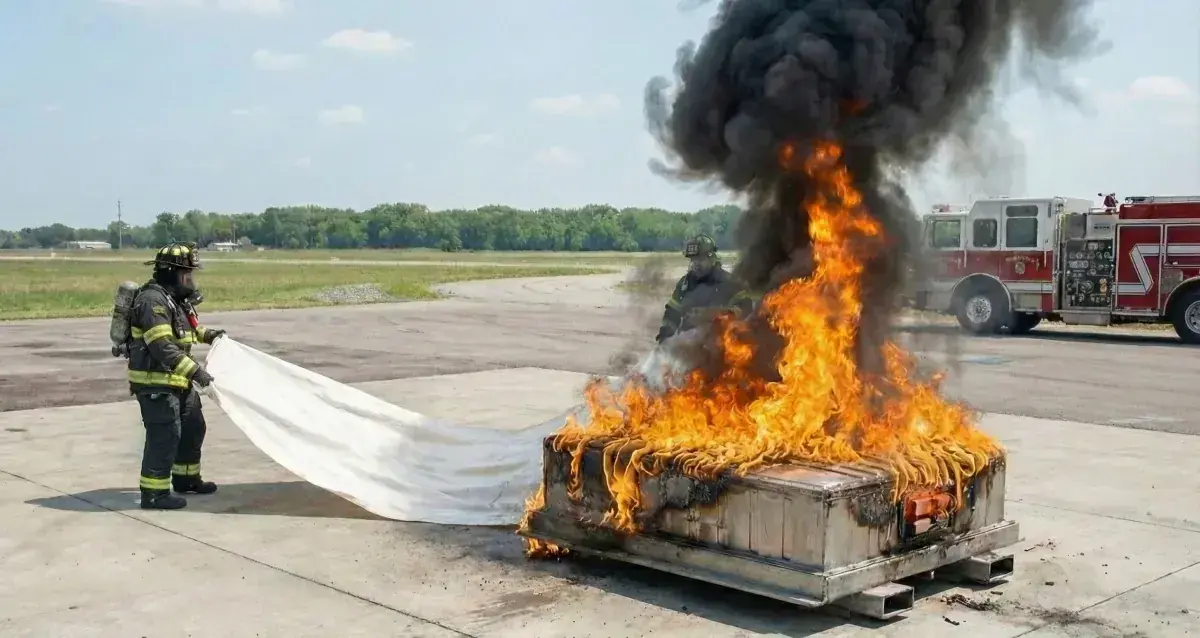
Key Takeaways
What Is a Fire Blanket?
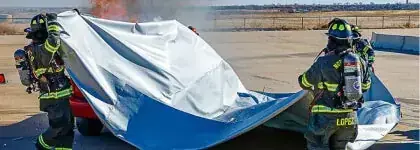
A fire blanket is a safety device made of fire-resistant materials designed to extinguish small fires by cutting off their oxygen supply. When placed over a fire, the blanket smothers the flames, preventing them from spreading and allowing the fire to die out.
Fire blankets have been used for over a century, evolving from simple wool blankets soaked in water to modern fiberglass designs that can withstand temperatures over 1,000°F. Today, they're a staple in commercial kitchens worldwide and are becoming increasingly popular in homes.
Unlike fire extinguishers, fire blankets require no training to use effectively. You simply pull the tabs to release the blanket, cover the fire completely, and wait. This simplicity makes them ideal for anyone—including children and elderly family members—to use in an emergency. According to research from UL, you may have as little as three minutes to escape a home fire—having a fire blanket within reach can mean the difference between a minor incident and a catastrophe.
Who Uses Fire Blankets?
Fire blankets aren't just for professional kitchens anymore. They've become essential safety equipment across multiple settings:
- Homeowners: The most common use case. Every kitchen should have one within arm's reach of the stove.
- Restaurants and Commercial Kitchens: Required by fire codes in most jurisdictions. Professional kitchens often have multiple blankets stationed throughout the cooking area.
- Laboratories: Chemical fires require specialized suppression, but fire blankets provide an immediate response option and can protect personnel during evacuation.
- Schools and Universities: Many educational institutions now require fire blankets in science labs, home economics rooms, and cafeteria kitchens.
- RV and Boat Owners: Compact spaces with cooking facilities make fire blankets ideal—they're small, require no maintenance, and work in confined areas.
- Welding and Fabrication Shops: Sparks and hot metal create constant fire risks. Fire blankets can quickly smother small fires before they spread.
Fire Blanket vs Wet Towel
Some people wonder: "Can't I just use a wet towel?" In theory, a wet towel can smother a very small fire. In practice, it's dangerous for several reasons:
- Steam burns: When water meets hot oil (350-450°F), it instantly vaporizes. A wet towel on a grease fire can cause steam explosions that spray burning oil.
- Insufficient coverage: Towels are thin and may not fully seal around a pan, allowing oxygen to continue feeding flames.
- Cotton ignites: Wet cotton can still catch fire when exposed to high enough temperatures, especially once the water evaporates.
- No hand protection: Fire blankets are designed to wrap around your hands, protecting you during deployment. A towel offers no such protection.
A proper fire blanket is woven fiberglass rated to withstand temperatures 3-4 times hotter than boiling water—specifically engineered for the job.
Warning: Never Put Water on a Grease Fire
Watch this dramatic demonstration to understand why water is dangerous.
Key takeaway: Water instantly vaporizes when it hits hot oil (350°F+), causing a violent steam explosion that sprays burning oil in all directions. This is why a fire blanket—not water—is the correct response to a grease fire.
Learn more: The History of Fire Blankets
How Do Fire Blankets Work?
Fire blankets work on a fundamental principle of fire science: fires need oxygen to burn. By completely covering a fire with a non-flammable blanket, you starve the flames of oxygen, causing them to extinguish.
The process works in three ways:
- Oxygen deprivation: The tight weave of the blanket prevents air from reaching the flames
- Heat containment: The fire-resistant material contains heat, preventing it from spreading to nearby objects
- Thermal barrier: The blanket protects the user's hands and arms while deploying
Most fire blankets are made of woven fiberglass, which can withstand temperatures up to 1,076°F (580°C). Premium silicone-coated blankets handle even higher temperatures—up to 1,800°F (982°C)—making them suitable for more intense fire situations.
Learn more: What Are Fire Blankets Made Of?
Do Fire Blankets Actually Work?
Yes—when used correctly on appropriate fires, fire blankets are highly effective. They're certified under rigorous international standards including:
- EN 1869:2019 (European standard)
- UL 94-2016, V-0 (US standard)
- AS/NZS 3504:2006 (Australian/New Zealand standard)
These certifications require blankets to successfully extinguish standardized test fires and maintain integrity under extreme heat. A certified fire blanket has been proven to work in laboratory conditions that simulate real emergencies.
The Statistics
According to the National Fire Protection Association (NFPA), cooking equipment is involved in nearly half (49%) of all reported home fires. The U.S. Fire Administration reports that unattended cooking is the leading cause of kitchen fires.
of cooking fires start with food or cooking materials
of fire injuries occur when fighting the fire
Source: National Fire Protection Association (NFPA)
That last statistic is crucial: one-third of injuries happen during fire suppression attempts. Fire blankets significantly reduce this risk because they provide a physical barrier between you and the flames, require no complex technique, and don't spray chemicals that can obscure vision or cause breathing difficulties.
The science behind fiberglass fire blankets explains why they're so effective—woven fiberglass creates an airtight barrier that withstands extreme temperatures while remaining flexible enough to conform to any shape.
Real-World Case Studies
We've documented numerous cases where fire blankets prevented small fires from becoming disasters:
"I was deep-frying chicken when the oil caught fire. Flames were shooting up toward my cabinets. I grabbed the fire blanket my daughter gave me for Christmas, threw it over the pan, and the fire was out in seconds. Without it, I'm certain I would have lost my kitchen—or worse."
— Martha R., Rochester, NY
"Our restaurant had a grease fire on the flat-top grill during the dinner rush. The cook grabbed the fire blanket instead of the extinguisher, covered it, and we were back to cooking in five minutes. With an extinguisher, we would have had to shut down for the night to clean up the mess."
— Chef Michael T., Austin, TX
These aren't isolated incidents. Fire blankets work because the physics is simple: no oxygen, no fire. There's no chemical reaction that can fail, no pressure gauge to check, no complicated technique to remember under stress.
Learn more: Do Fire Blankets Really Work?
When to Use a Fire Blanket
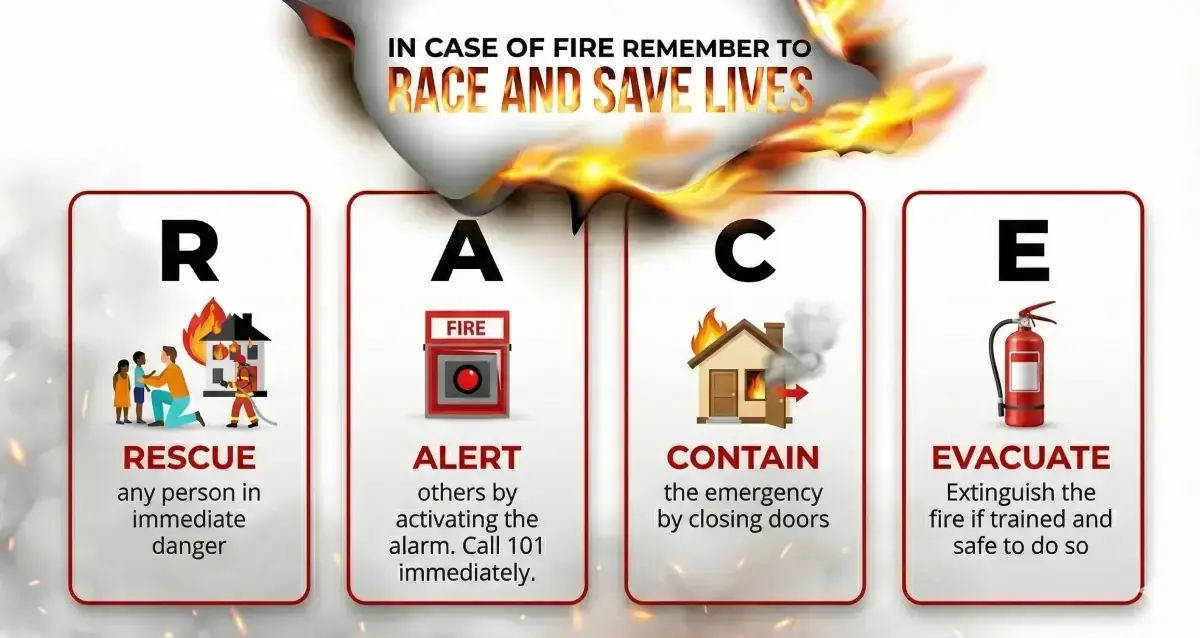
Fire blankets excel in specific situations where their smothering action is most effective. In fire safety training, you'll often hear about the RACE acronym—Rescue, Alarm, Contain, Extinguish—which provides the standard framework for responding to any fire emergency. Fire blankets fit perfectly into the Contain and Extinguish steps of this procedure.
Kitchen and Stovetop Fires
The most common use for fire blankets. When cooking oil ignites or a pan catches fire, a fire blanket can be deployed in seconds to smother the flames. This is far safer than using water, which can cause a grease fire to explode.
Grease Fires
Grease fires burn at extremely high temperatures and can't be extinguished with water. A fire blanket is one of the safest ways to handle a grease fire—simply cover the burning pan and leave it covered until completely cooled.
Clothing Fires
If someone's clothing catches fire, a fire blanket can wrap around them to smother the flames. This is particularly important because the "stop, drop, and roll" technique doesn't always work on synthetic fabrics.
Small Contained Fires
Wastebasket fires, small campfires that need quick extinguishing, or any fire smaller than a trash can that's not spreading—these are all appropriate for fire blanket use.
Learn more: How to Prevent Kitchen Fires | Why Water Makes Grease Fires Worse
When NOT to Use a Fire Blanket
Knowing when not to use a fire blanket is just as important as knowing when to use one. In these situations, evacuate and call 911:
| Situation | Why Not | What to Do Instead |
|---|---|---|
| Electrical fires (still powered) | Electricity continues flowing under blanket | Cut power first, then use blanket or Class C extinguisher |
| Fires larger than a trash can | Blanket can't cover completely | Evacuate, call 911 |
| Chemical fires | May create toxic fumes or react with blanket | Evacuate, call 911, report chemicals |
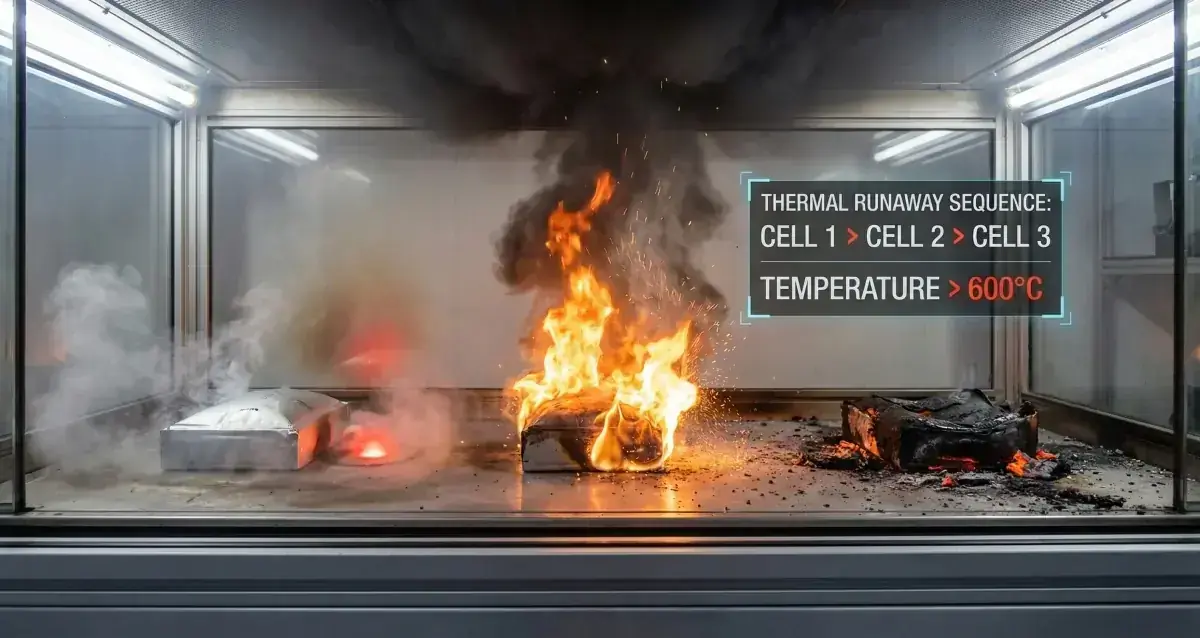
| Lithium battery fires | Batteries create their own oxygen | Use Class D extinguisher, call 911 |
| Fire blocking your exit | Don't risk your escape route | Find alternate exit, call 911 |
Learn more: 7 Dangerous Situations to Avoid
How to Use a Fire Blanket
Using a fire blanket is straightforward, but proper technique matters. Follow these seven steps:
Quick Reference: 7 Steps
Memorize these steps before an emergency occurs.
Watch: How to Use a Fire Blanket
See proper technique demonstrated step-by-step.
Common Mistakes to Avoid
- Lifting the blanket too soon to check—wait the full 30 minutes
- Not covering the fire completely—edges must be sealed
- Approaching from above—always approach from the side, staying low
- Forgetting to turn off the heat source
Learn more: Complete Fire Blanket Usage Guide | Emergency Response Guide
Fire Blanket Types & Materials
Not all fire blankets are created equal. The material determines how much heat the blanket can handle and its best use case:
| Type | Temperature Rating | Best For | Price Range |
|---|---|---|---|
| Fiberglass | Up to 1,076°F | Home kitchens, general use | $20-40 |
| Silicone-Coated | Up to 1,800°F | Workshops, grills, commercial | $50-100 |
| Aramid Fiber | Up to 2,000°F+ | Industrial, welding | $100+ |
| EV Fire Blanket | Up to 2,912°F | Electric vehicles, lithium batteries | $500+ |
For most homes, a standard fiberglass fire blanket is sufficient. It handles kitchen fires, grease fires, and most common household fire emergencies. Consider silicone-coated blankets if you have a workshop, do outdoor grilling frequently, or want extra peace of mind.
Learn more: Silicone Fire Blankets: When You Need Them | Are All Fire Blankets the Same?
Fire Blanket vs Fire Extinguisher
Both fire blankets and fire extinguishers have their place in home fire safety. Here's how they compare:
| Factor | Fire Blanket | Fire Extinguisher |
|---|---|---|
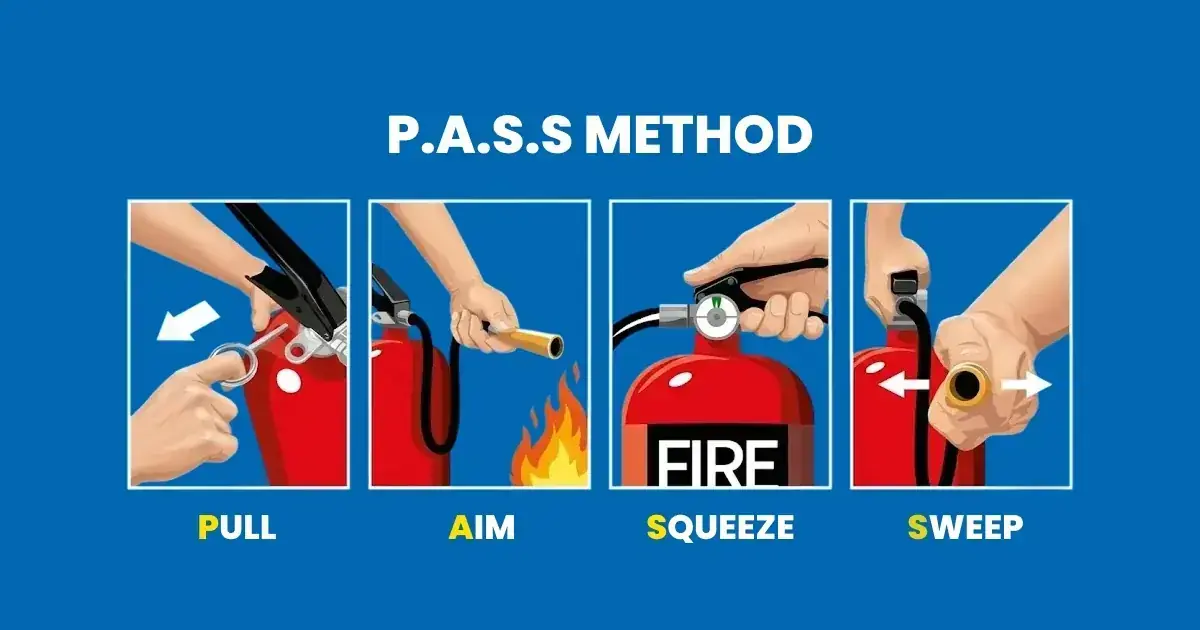
| Ease of Use | No training needed | Requires PASS technique training |
| Maintenance | None required | Annual inspection, recharging |
| Mess | None | Chemical residue cleanup |
| Grease Fires | Excellent (smothers safely) | Good (Class K only) |
| Larger Fires | Limited (must cover completely) | Better (can spray from distance) |
| Lifespan | 5-7+ years | 5-12 years (with maintenance) |
| Cost | $20-50 | $30-100+ |
Our recommendation: Have both. Fire blankets for kitchen and grease fires, extinguishers for larger or spreading fires. They complement each other.
Learn more: Complete Fire Blanket vs Extinguisher Comparison | Fire Extinguisher Classes Explained | When to Replace a Fire Extinguisher
Where to Place Your Fire Blanket
Strategic placement ensures you can reach your fire blanket quickly in an emergency:
Kitchen (Primary Location)
- Within 10 feet of your stove
- NOT directly above the stove (heat rises)
- At eye level for easy access
- Away from potential fire sources
Additional Locations
- Garage/Workshop: Near workbench, away from heat sources
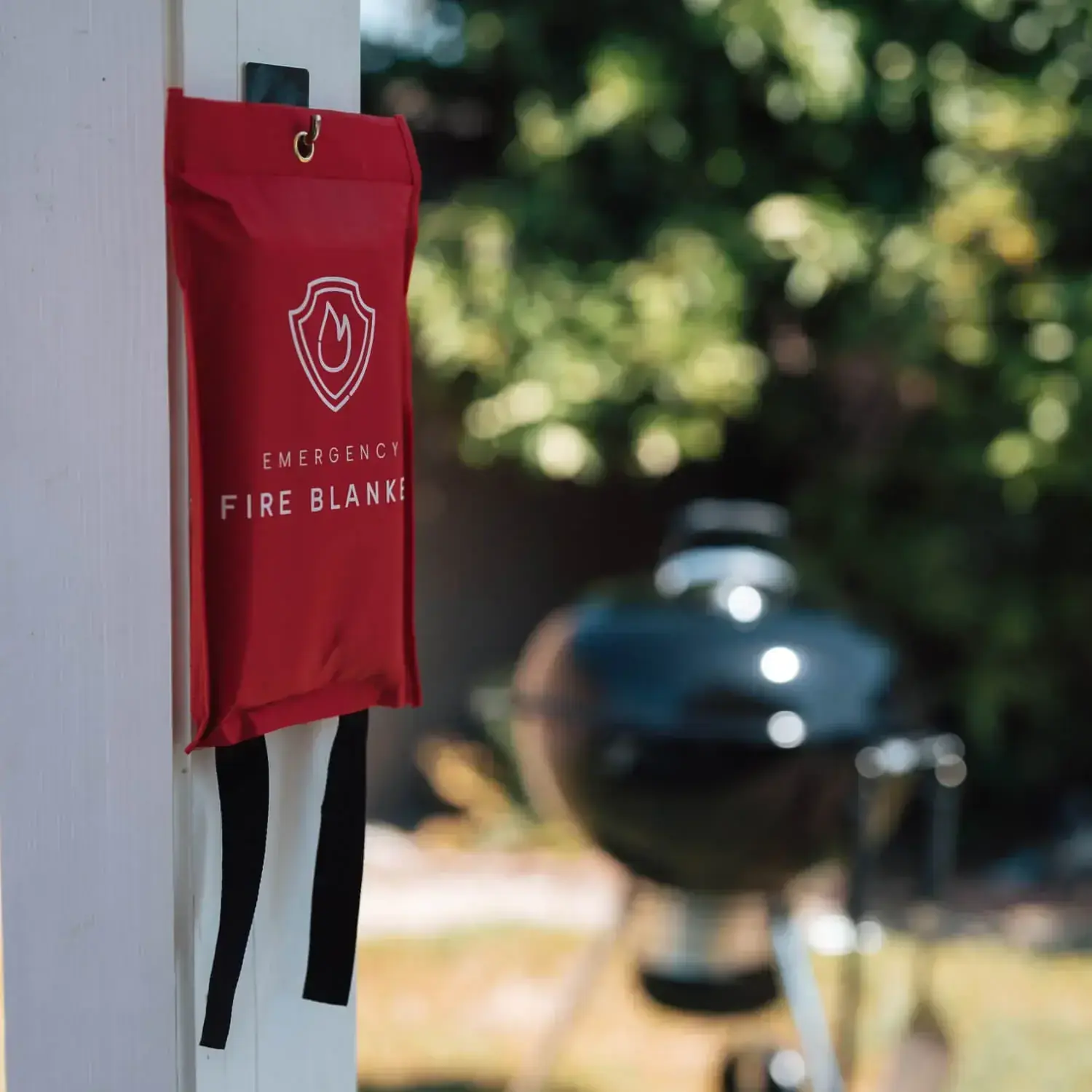
- Near Outdoor Grill: In a shaded area, protected from weather
- RV/Boat: Near cooking area, secured against movement
- Bedroom: For multi-story homes as emergency escape aid
Fire Blankets for Specific Spaces
Kitchen Fire Blankets
The kitchen is ground zero for home fires. Your primary fire blanket should be mounted on the wall, ideally on the side of a cabinet, within 10 feet of your stove but not directly above it (heat rises, and you don't want to reach over flames to grab it). A standard 39"x39" blanket is sufficient for most stovetop fires, but if you have a large range or do a lot of deep frying, consider a 47"x47" blanket.
Garage and Workshop Fire Blankets
Garages present unique fire risks: gasoline, oil, paint thinners, power tools that create sparks, and often poor ventilation. A silicone-coated fire blanket is recommended here since it handles higher temperatures. Mount it near your workbench but away from the wall where you store flammables. Consider a larger size (47"x47" or larger) to handle workbench fires that may be larger than a typical pan fire.
Fire Blankets for Grilling
Outdoor grills—especially gas grills—can flare up unexpectedly. Keep a fire blanket in a weatherproof container or bag near your grilling station. It should be close enough to grab quickly but not so close that a grill fire could prevent you from reaching it. A standard 39"x39" blanket works for most grill fires.
RV and Marine Fire Blankets
Compact spaces make fire blankets even more valuable. In an RV or boat, you can't easily escape, and fires spread quickly in confined areas. Mount the blanket near the galley but ensure it's secured so it doesn't shift during travel. Look for blankets with compact storage pouches designed for tight spaces.
Make sure everyone in your household knows where fire blankets are located. Walk through the locations with family members and practice the deployment steps.
Learn more: Fire Blankets for Kitchen Safety | Fire Blankets for Garage & Workshop
Maintenance & Lifespan
One of fire blankets' biggest advantages is their minimal maintenance requirements:
Do Fire Blankets Expire?
Quality fire blankets don't have a hard expiration date like fire extinguishers. However, most manufacturers recommend replacement after 5-7 years, or immediately if you notice any damage.
Inspection Checklist
Inspect your fire blankets quarterly:
- Check the container/pouch for damage or deterioration
- Ensure pull tabs are accessible and functional
- Look for contamination (oil, dust buildup)
- Verify the blanket hasn't been tampered with
- Check mounting hardware is secure
After Use
If you've used a fire blanket on a significant fire, replace it. The fiberglass fibers may have fused or been damaged by heat. For minor uses (small flare-ups), inspect thoroughly before reusing.
Learn more: Do Fire Blankets Expire? | Fire Blanket Maintenance Schedule | Are Fire Blankets Reusable?
Common Myths
Common Myths
Fire blankets only work on small fires
Fire blankets work on any fire they can completely cover. The 39"x39" standard size handles most stovetop and pan fires effectively.
Fire blankets are single-use only
Blankets used on small fires may be reusable if undamaged. Always inspect after use, but don't assume you need a new one after every deployment.
Fire extinguishers are always better
For grease fires and small kitchen fires, fire blankets are often safer and more effective. They don't spread grease and create no cleanup mess.
Fire blankets expire quickly
Quality fire blankets last 5-7+ years with no maintenance. They don't lose pressure or need recharging like extinguishers.
Learn more: All Fire Blanket Myths Debunked
How to Choose a Fire Blanket
When shopping for a fire blanket, prioritize these factors:
1. Certifications (Non-Negotiable)
Only buy blankets certified to recognized standards:
- EN 1869:2019 (European)
- UL 94-2016, V-0 (United States)
- AS/NZS 3504:2006 (Australia/New Zealand)
No certification? Don't buy it.
2. Size
- 39"x39" (1m x 1m): Standard home kitchen use
- 47"x47" or larger: Commercial kitchens, workshops
- 6'x8'+: Industrial, vehicle fires
3. Material
- Fiberglass: Best value for home use
- Silicone-coated: Higher heat resistance, workshop use
4. Packaging
- Quick-release tabs that work under stress
- Wall-mountable container
- Clear instructions on the packaging
Ready to buy? See our Complete Fire Blanket Buying Guide for detailed product comparisons and recommendations.
Home Fire Safety Checklist
A fire blanket is one piece of a comprehensive home fire safety plan. Use this checklist to ensure your home is properly protected:
Kitchen Safety
- Fire blanket mounted within 10 feet of stove (not directly above)
- Pot handles turned inward to prevent accidental bumps
- Flammable items (towels, curtains, paper) kept away from burners
- Smoke detector installed within 20 feet of kitchen
- Fire extinguisher accessible (Class K for commercial, ABC for home)
- Stove and oven cleaned regularly to prevent grease buildup
- Never leave cooking unattended, especially when frying
Throughout the Home
- Smoke detectors on every floor and in every sleeping area
- Smoke detector batteries tested monthly, replaced annually
- Carbon monoxide detectors on every floor
- Fire escape plan established and practiced twice yearly
- Two exits identified from every room
- Meeting spot designated outside the home
- Address numbers visible from the street for emergency responders
Electrical Safety
- Extension cords used temporarily, not as permanent wiring
- Outlets not overloaded with multiple high-draw devices
- Frayed or damaged cords replaced immediately
- Space heaters kept 3+ feet from flammables
- AFCI breakers installed in bedrooms (required in new construction)
Heating and Fireplace
- Furnace and chimney inspected annually
- Fireplace screen in place when fire is burning
- Ashes disposed of in metal container, kept outside
- Flammable materials kept 3+ feet from fireplace and heaters
Print this checklist and walk through your home room by room. Fire safety isn't a one-time task—review this list quarterly and after any major changes to your home.
Specialized Topics & Deep Dives
Lithium Battery & EV Fires
Electric vehicles and lithium-ion batteries present unique fire challenges. Traditional fire blankets may not be sufficient—specialized EV fire blankets rated for 2,000°F+ are recommended. For comprehensive coverage of this topic, see our dedicated EV Fire Blanket Guide.
- Complete EV Fire Blanket Guide - Everything about electric vehicle fire containment
- What Is Thermal Runaway? - Understanding the science behind battery fires
- How to Put Out a Lithium Battery Fire - Step-by-step response guide
- Reims E-Scooter Fire Tragedy - Lessons from a deadly battery fire
Commercial & Industrial Applications
Fire blanket use extends beyond home kitchens into professional settings with unique requirements.
- Factory Fire Blanket Strategy - Industrial fire safety planning
- Senior Living Fire Safety - Lessons from the Rochester apartment fire
Industry Trends
- Why Fire Blanket Sales Are Surging - Market trends and what's driving adoption
Frequently Asked Questions
What is a fire blanket used for?
A fire blanket is used to extinguish small fires by smothering them and cutting off oxygen supply. They're ideal for kitchen fires, grease fires, clothing fires, and small contained fires. Fire blankets are especially effective for cooking oil fires where water would be dangerous.
Are fire blankets better than fire extinguishers?
Fire blankets and extinguishers serve different purposes. Fire blankets are better for small contained fires, grease fires, and clothing fires. They require no training, create no mess, and never expire. Fire extinguishers are better for larger fires and can spray from a distance. Most homes benefit from having both.
How long do fire blankets last?
Quality fire blankets last 5-7 years or longer when stored properly. Unlike fire extinguishers, they don't require annual servicing or recharging. Inspect your fire blanket quarterly for damage, and replace if you notice tears, contamination, or degraded packaging.
Can you reuse a fire blanket?
Fire blankets used on small fires may be reusable if undamaged. However, blankets used on serious fires should be replaced as the fiberglass may have fused or weakened. Always inspect thoroughly after any use and replace if in doubt—your safety isn't worth the risk.
What size fire blanket do I need?
For home kitchens, a 39"x39" (1m x 1m) fire blanket is standard and sufficient for most stovetop fires. Larger blankets (4'x6' or 6'x8') are recommended for workshops, garages, or commercial kitchens where larger fires might occur.
Where should I keep a fire blanket?
Mount your primary fire blanket in the kitchen, within 10 feet of the stove but not directly above it. Additional blankets should be placed in garages, workshops, near outdoor grills, and in RVs or boats. Ensure everyone in the household knows the locations.