
Key Takeaways
Why EV Fires Are Different
Electric vehicle fires aren't just "car fires with a different fuel source." They're fundamentally different emergencies that require specialized equipment and response protocols.
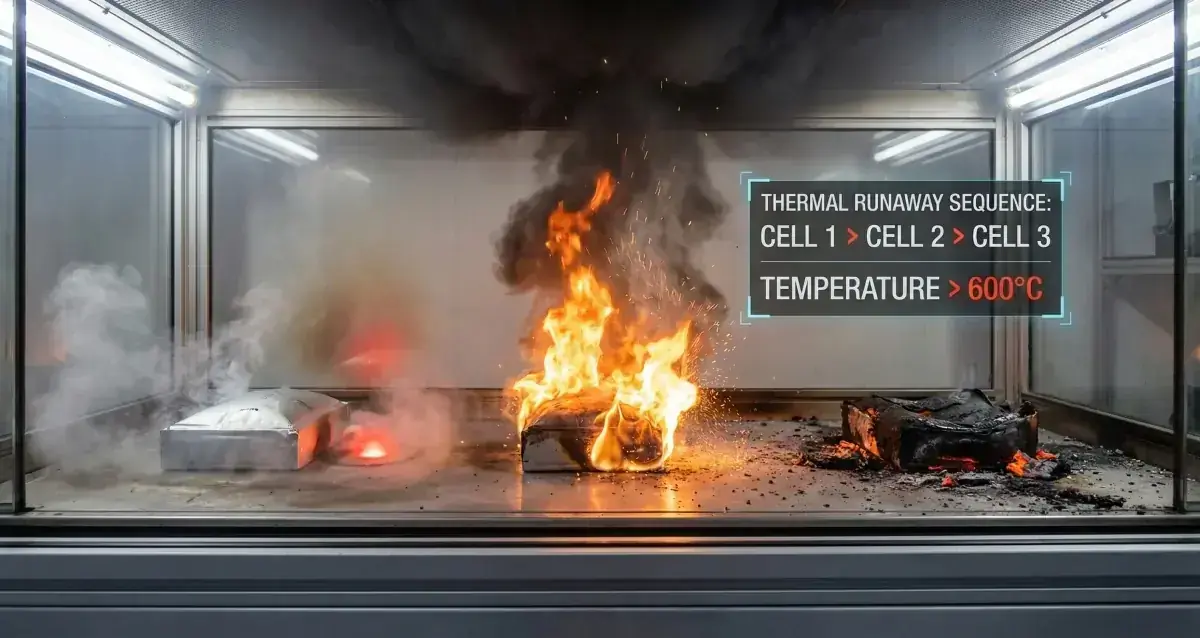
When a lithium-ion battery fails, it undergoes a process called thermal runaway. The battery cells heat uncontrollably, releasing flammable gases and generating their own oxygen through chemical decomposition. This creates a self-sustaining reaction that traditional firefighting methods cannot stop.
EV battery fires burn nearly 3x hotter than traditional gasoline fires. This extreme heat melts standard fire blankets (rated to ~1000°F), burns through typical protective equipment, and can damage concrete and asphalt.
Why Water Doesn't Work on EV Fires
Traditional fire suppression relies on water to cool fires below their ignition temperature and deprive them of oxygen. Neither approach works on lithium battery fires:
- Batteries create their own oxygen through chemical decomposition—you can't suffocate them with water
- Water creates steam explosions when it contacts 2000°F+ surfaces
- Contaminated runoff spreads toxic heavy metals into the environment
- Fires reignite repeatedly—even after appearing extinguished
EV battery fires release toxic gases including hydrogen fluoride (HF), carbon monoxide (CO), and hydrogen cyanide. Always maintain distance and use respiratory protection.
Toxic Gas Hazards
Beyond the extreme heat, EV fires release a cocktail of toxic gases that pose immediate health risks:
- Hydrogen Fluoride (HF): Can cause severe burns and lung damage even at low concentrations
- Carbon Monoxide (CO): Colorless, odorless poison that causes rapid incapacitation
- Lithium compounds: Caustic materials that contaminate everything they contact
- Heavy metals: Cobalt, nickel, and manganese particles that persist in the environment
This is why EV fire blankets serve a dual purpose: they contain both the fire AND the toxic gases, protecting responders and bystanders.
How EV Fire Blankets Work
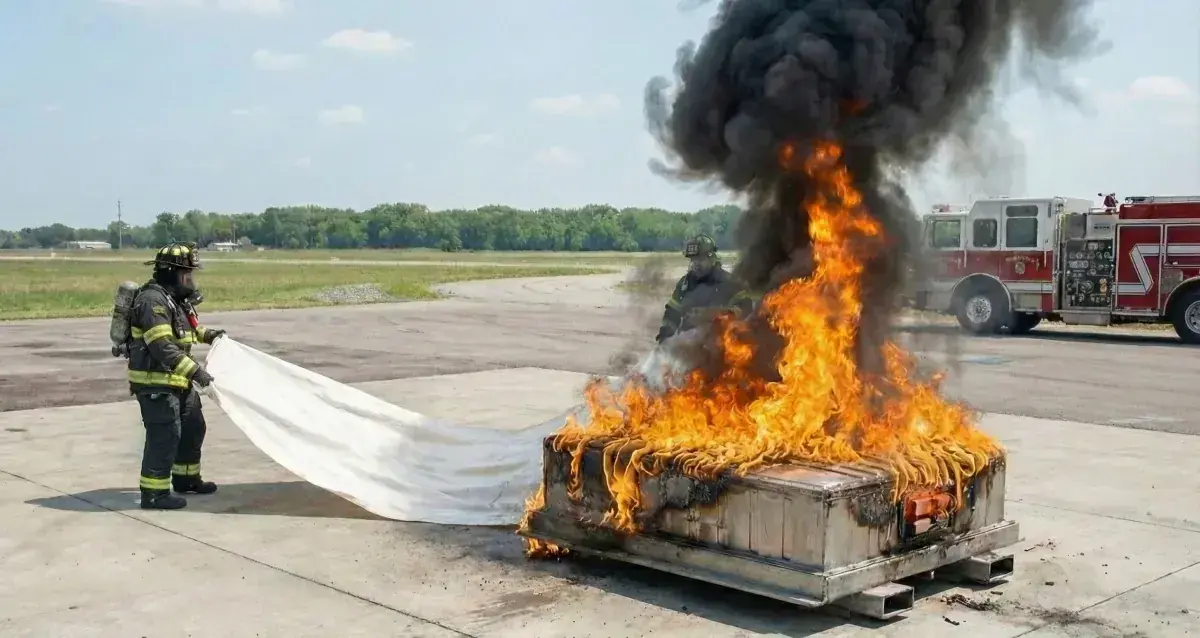
EV fire blankets don't "extinguish" battery fires in the traditional sense. Instead, they contain the emergency by creating a physical barrier that:
- Cuts off oxygen supply: While batteries create internal oxygen, the surrounding fire needs external O2. The blanket starves secondary fires.
- Traps toxic gases: The dense, heat-resistant material prevents deadly fumes from spreading to nearby people.
- Contains radiant heat: Prevents the fire from spreading to adjacent vehicles, structures, or vegetation.
- Buys critical time: Provides 45+ minutes for evacuation and emergency response.
Our EV fire blankets are constructed from silicone-coated high-temperature fiberglass with a melting point of 2912°F—well above the 2000°F+ temperatures of EV battery fires. This is the highest rating in the industry.
Pro Tip: Unlike water suppression that may require thousands of gallons over hours, a single properly-sized fire blanket can contain an EV fire for the duration of the emergency with no additional resources.
2025 NFPA Research: Explosion Hazard Findings
In May 2025, the National Fire Protection Association (NFPA) and Fire Safety Research Institute (FSRI) released findings from EV fire suppression experiments. This prompted the International Association of Fire Fighters (IAFF) to issue an advisory. Here's what you need to know—and the critical context often missing from headlines.
What the Research Found
During controlled experiments at Rockland County Fire Training Ground, researchers tested worst-case scenarios:
- Batteries charged to over 100% state of charge (maximum vapor release)
- Heavy water applied to blanket tops, which sealed edges and trapped gases
- Test protocol intentionally lifted blankets at the one-hour mark to observe vapor ignition
The critical finding: explosions only occurred when the blanket was lifted, introducing oxygen to accumulated flammable gases. When blankets remained in place without disturbance, no deflagration events occurred.
Never lift, adjust, or peek under an EV fire blanket once deployed. The explosion risk comes from improper removal—not from the blanket itself. Maintain complete coverage until professionals clear the scene.
Proper Deployment & Removal Protocol
Based on the U.S. Fire Administration guidance and industry best practices:
- Maintain 3+ foot ground seal: Lay blanket flat around entire vehicle perimeter—this allows vapors to vent safely rather than trapping them
- Do not add water on top: Water pooling seals edges and makes removal dangerous
- Wait 30-60 minutes minimum: After the last sign of fire or battery venting before any removal attempt
- Monitor before removal: Check for CO and flammable environment; use thermal imaging to identify hot spots indicating continued thermal runaway
- Slide—don't lift: Keep blanket close to ground during removal; slide it off rather than lifting edges
- Have suppression ready: Keep handlines at the ready to push vapors away or extinguish any flames during removal
Why Fire Blankets Remain Essential
EV fire blankets have proven effective in hundreds of real-world deployments worldwide. The NFPA/FSRI research doesn't diminish their value—it reinforces proper protocol:
- Suppress visible flames immediately by cutting external oxygen
- Contain toxic gases (hydrogen fluoride, carbon monoxide) from spreading
- Prevent fire spread to adjacent vehicles and structures
- Buy critical evacuation time for people and emergency response
The hazard only emerges from improper blanket removal. With correct ground seal and removal protocol, EV fire blankets remain the most effective tool for containing electric vehicle fires where water suppression isn't viable.
How to Put Out a Lithium Battery Fire
Here's the truth: you cannot "put out" a lithium battery fire in the traditional sense. The thermal runaway reaction is self-sustaining—it generates its own oxygen through chemical decomposition. No amount of water, foam, or CO2 will stop it.
What you CAN do is contain the fire while it burns itself out safely. For a complete breakdown by device type, see our guide on how to put out a lithium battery fire.
For Large EV/Vehicle Batteries
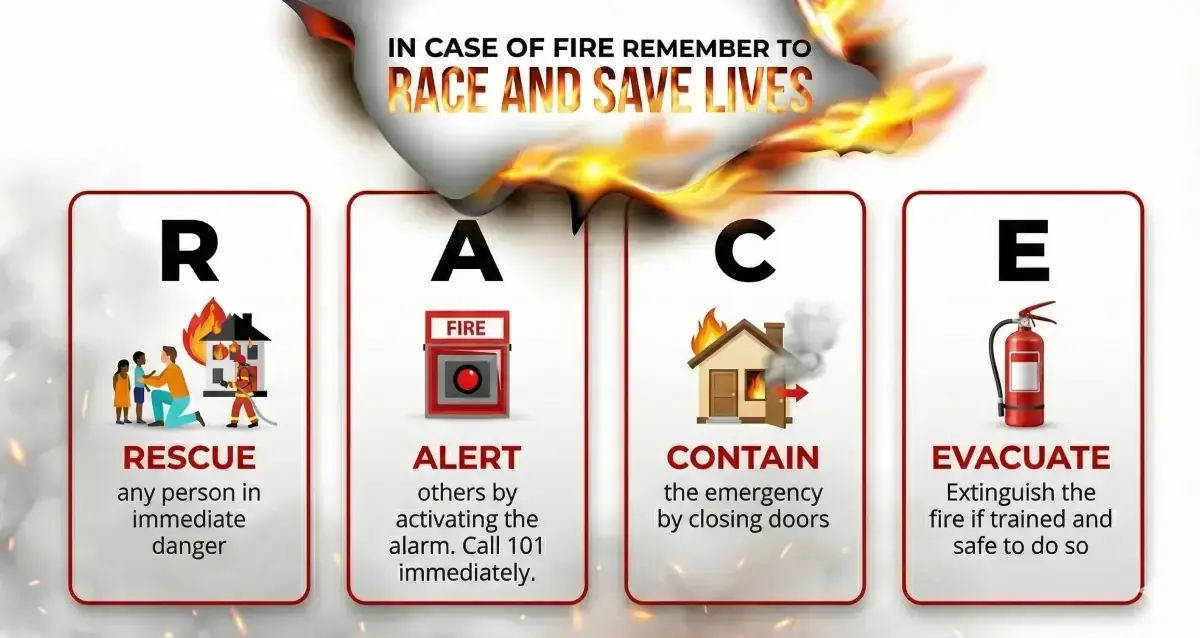
- Evacuate immediately—get everyone 50+ feet away from the vehicle
- Call 911—report an electric vehicle battery fire specifically
- Deploy EV fire blanket if trained and equipped (2-person minimum)
- Do not attempt water suppression—it's ineffective and creates runoff hazards
- Maintain blanket coverage for minimum 45 minutes without disturbing
- Wait for professional response—EV fires require specialized protocols
For Small Lithium Batteries (E-bikes, Scooters, Devices)
Smaller lithium battery fires from e-bikes, e-scooters, hoverboards, or devices follow similar principles but with some differences:
- Evacuate the room—lithium fires produce toxic gases rapidly
- Close the door if possible to contain smoke and gases
- Call 911—even small battery fires can reignite and spread
- Use a fire blanket to smother if safe to approach (our standard fire blanket works for small devices)
- Do not use water—it can cause violent reactions with lithium
- Move outdoors if possible—only if you can do so safely without carrying burning device
E-bike and e-scooter fires are the fastest-growing category of lithium battery fires—a 2025 apartment fire in France killed four people when an e-scooter ignited overnight. Never charge these devices overnight, near exits, or using non-manufacturer chargers. Store away from bedrooms and escape routes.
What NOT To Do
- Don't use water—ineffective and spreads contaminated runoff
- Don't use standard fire extinguishers—they cannot stop thermal runaway
- Don't try to move a burning EV—battery projectiles can eject
- Don't assume it's out—EV batteries reignite hours or days later
- Don't inhale the smoke—contains hydrogen fluoride and other toxic compounds
EV Fire Blanket vs Fire Extinguisher
Many people wonder: "Can't I just use a fire extinguisher on an EV fire?" The short answer is no—and here's why:
| Factor | EV Fire Blanket | Fire Extinguisher |
|---|---|---|
| EV Battery Fires | Effective (contains) | Ineffective (can't extinguish) |
| Temperature Rating | 2000°F+ (ours: 2912°F) | N/A |
| Toxic Gas Containment | Yes - traps HF, CO, and other gases | No - gases escape freely |
| Reignition Prevention | Yes (45+ min coverage) | No - fire reignites |
| Water Required | No | Some types need water |
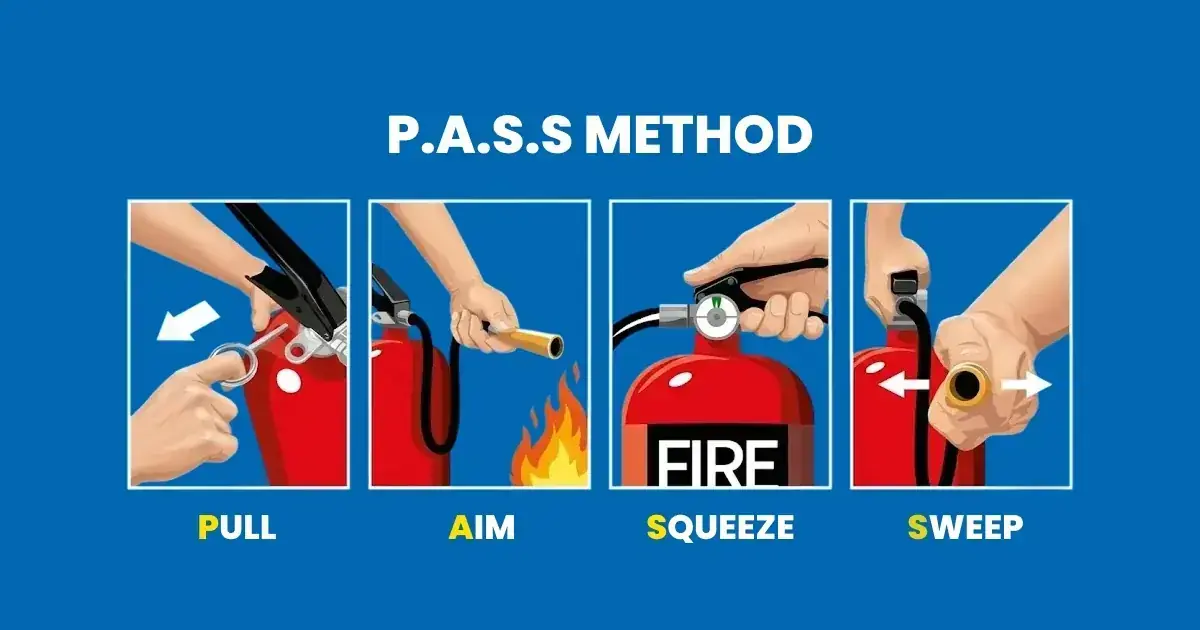
| Training Required | Basic (2-person deployment) | PASS technique |
Fire extinguishers—even Class D extinguishers designed for metal fires—cannot stop lithium battery thermal runaway. The chemical reaction is self-sustaining and generates its own oxygen. Extinguishers may suppress visible flames temporarily, but the fire will reignite.
EV fire blankets take a different approach: instead of trying to extinguish the unstoppable, they contain the fire while it burns itself out safely.
Our recommendation: EV fire blankets are essential for battery fire emergencies. A traditional extinguisher can still be useful for secondary fires on surrounding materials—but the blanket is your primary defense.
Choosing the Right Size
Choosing the correct size EV fire blanket is critical. The blanket must completely cover the vehicle AND extend to the ground on all sides to effectively contain gases and prevent fire spread.
| Size | Dimensions | Fits |
|---|---|---|
| Standard | 20' x 25' | Tesla Model 3/Y, sedans, compact SUVs, e-bikes |
| X-Large | 23' x 26' | Tesla Model S/X, full-size SUVs, pickup trucks |
| XL Extended | 25' x 33' | Cybertruck, large trucks, commercial vans |
| 2X-Large | 26' x 33' | Transit vans, box trucks, heavy equipment |
When in doubt, size up. A blanket that's slightly too large still works perfectly. A blanket that's too small fails to contain gases and allows fire spread.
Vehicle-Specific Recommendations
- Tesla Model 3/Y: Standard (20'x25') provides full coverage
- Tesla Model S/X: X-Large (23'x26') recommended for sedan/SUV footprint
- Cybertruck: XL Extended (25'x33') for the larger truck dimensions
- Rivian R1T/R1S: X-Large or XL Extended based on model
- Ford F-150 Lightning: XL Extended (25'x33') for full truck coverage
- E-bikes and scooters: Standard size works, though our home fire blanket may suffice for smaller devices
How to Deploy an EV Fire Blanket
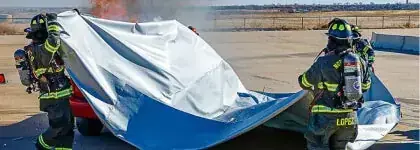
Proper deployment technique is essential for both effectiveness and safety. Always use a minimum of 2 people for EV fire blanket deployment.
6-Step Deployment Protocol
EV batteries can eject projectiles during thermal runaway. Always approach from the sides of the vehicle, never from the front (hood) or rear (trunk) where battery modules may be located.
Who Uses EV Fire Blankets
EV fire blankets have rapidly become standard equipment across multiple industries and applications:
Professional First Responders
- Fire departments worldwide have adopted EV fire blankets as standard equipment
- Standard equipment on many modern fire apparatus
- Required by some municipalities for EV incident response
Commercial & Fleet Operations
- Fleet managers protecting electric delivery vehicles
- Rental car companies with EV inventory
- Rideshare operators managing driver safety
- Public transit agencies with electric buses
Facility Operators
- Parking structure operators protecting against garage fires
- EV charging station owners and charging networks
- Car dealerships with EV inventory on the lot
- Auto body shops working on damaged EVs
Transportation & Logistics
- Maritime and ferry operators transporting EVs on ships
- Tunnel authorities managing enclosed roadways
- Airports with electric ground support equipment
- Tow truck operators recovering damaged EVs
Homeowners
- Garage charging where fires could spread to the home
- E-bike and e-scooter owners charging indoors
- Anyone seeking peace of mind with EV ownership
Technical Specifications
Our EV fire blankets are engineered to the highest standards in the industry:
| Specification | Value |
|---|---|
| Material | Silicone-coated high-temp fiberglass |
| Softening Point | 1350-1600°F (732-871°C) |
| Melting Point | 2912°F (1600°C) |
| Fire Resistance | UL 94 V-0 (highest rating) |
| PFAS | PFAS-Free certified |
| Designed In | California, USA |
| Weight (Standard) | ~35 lbs |
Why Melting Point Matters
Our 2912°F melting point is the highest in the industry. For comparison:
- Standard kitchen fire blankets: ~1000°F (will fail on EV fires)
- Some competitor EV blankets: 2050°F (marginal safety margin)
- Our EV blankets: 2912°F (45%+ safety margin above fire temps)
The higher melting point provides critical safety margin. EV fires can spike above 2000°F during intense thermal runaway events—a blanket rated close to that temperature risks failure at the worst possible moment.
Single-Use: Why It Matters
EV fire blankets are single-use only. After exposure to an EV fire, blankets must be disposed of properly—they cannot be cleaned, inspected, or reused. Here's why:
Toxic Contamination
EV battery fires release heavy metals that embed in the blanket material:
- Cobalt: Carcinogenic and can cause serious respiratory damage
- Nickel: Allergenic and potentially carcinogenic with prolonged exposure
- Lithium compounds: Caustic materials that cause chemical burns
- Manganese: Neurotoxic at elevated exposure levels
In 2024, two Australian firefighters suffered permanent cobalt poisoning after responding to an EV fire. The contamination came from handling materials exposed to the battery fire. This is why single-use design protects first responders.
Material Degradation
Beyond contamination, the extreme heat of EV fires causes irreversible material changes:
- Fiberglass fibers may fuse or become brittle
- Silicone coating degrades at sustained high temperatures
- Structural integrity cannot be verified after use
- No field testing method exists to confirm continued safety
The bottom line: Some competitors market "reusable" EV blankets. This is dangerous marketing that puts first responders at risk. After any EV fire deployment, replace the blanket.
Where to Place EV Fire Blankets
Strategic placement ensures you can respond quickly when seconds matter:
Home Garage
- Near the EV charging station but not directly above it
- Accessible from both the vehicle and the exit
- Wall-mounted for visibility and quick access
- Protected from extreme temperatures and moisture
Commercial Parking Structures
- One blanket per parking level minimum
- Near emergency call stations or fire equipment cabinets
- Clearly marked with signage visible from a distance
- Additional blankets near dedicated EV charging areas
EV Charging Hubs
- Within 50 feet of all charging stations
- Protected from weather in outdoor locations
- Staff trained on deployment procedures
Fleet Depots
- Central location accessible to all vehicle parking
- Secondary blanket on recovery/tow vehicles
- Integrated into fleet safety protocols
Frequently Asked Questions
Can a fire blanket put out an EV battery fire?
Yes, but "put out" is misleading. EV fire blankets contain fires by cutting oxygen and trapping toxic gases. They don't extinguish the thermal runaway inside the battery but prevent fire spread and buy 45+ minutes for safe evacuation and emergency response.
What size EV fire blanket do I need for a Tesla?
For Tesla Model 3 and Model Y, our Standard size (20'x25') provides full coverage. For Model S, Model X, and Cybertruck, we recommend the X-Large (23'x26') or XL Extended (25'x33') to ensure complete vehicle coverage including ground clearance.
How hot do EV fires burn?
EV battery fires can exceed 2000°F (1100°C), nearly 3x hotter than gasoline fires (~700°F). This is why standard fire blankets (rated to 1000°F) fail catastrophically. You need a blanket rated to 2500°F+ minimum.
Can I reuse an EV fire blanket?
No. After exposure to an EV fire, blankets become contaminated with toxic heavy metals including cobalt, nickel, and lithium compounds. Two Australian firefighters suffered permanent cobalt poisoning from EV fire response. Reusing a contaminated blanket risks secondary exposure.
Why can't you use water on EV fires?
Water doesn't extinguish lithium-ion thermal runaway—the battery creates its own oxygen through chemical decomposition. Water can also cause dangerous steam explosions and spreads toxic contaminated runoff. Fire blankets contain the fire without water.
How long should an EV fire blanket stay on the vehicle?
Minimum 45 minutes. EV batteries can reignite multiple times as thermal runaway spreads through battery cells. Some fire departments leave blankets for 24+ hours before attempting vehicle recovery.
Do fire departments use EV fire blankets?
Yes. Fire departments worldwide have adopted EV fire blankets as standard equipment for EV fire response. Traditional water suppression is ineffective against lithium battery thermal runaway.
What certifications should an EV fire blanket have?
Look for: UL 94 V-0 fire resistance rating (highest flammability standard), melting point above 2500°F, and PFAS-free materials. Our blankets are rated to 2912°F—the highest in the industry—and are trusted by professional fire departments.
Can EV fire blankets explode?
The blanket itself doesn't explode. The 2025 NFPA/FSRI tests found that explosions only occurred when blankets were lifted, introducing oxygen to accumulated flammable gases underneath. When blankets remained in place undisturbed, no explosions occurred. The risk is in improper removal—not the blanket itself. Maintain a 3+ foot ground seal and never lift edges once deployed.
How do you put out a lithium battery fire?
You don't "put out" lithium battery fires—you contain them. The thermal runaway reaction generates its own oxygen and cannot be extinguished. Use an EV fire blanket to contain the fire, trap toxic gases, and prevent spread while it burns itself out. Wait 30-60 minutes after the last sign of fire before removal, then slide (don't lift) the blanket off.
What did the 2025 NFPA testing reveal about EV fire blankets?
The tests—conducted at over 100% state of charge with water pooling that sealed edges—found that flammable gases can accumulate under blankets during thermal runaway. Critical finding: explosions only happened when blankets were lifted to remove pooled water. With proper 3+ foot ground seal allowing vapors to vent, and slide-off removal technique, EV fire blankets remain effective and safe.